Empowering End-to-End Research and Development of Innovative Biologics

Pharmolix Inc. — A Leader in Multimodal Foundation Models and Intelligent Agent Platforms for Biopharmaceuticals

PHARMOLIX R&D

Advancing Our Proprietary Pipeline with AI

At PharMolix, we combine drug discovery expertise with multimodal biomedical foundation models and intelligent agents to advance our proprietary pipeline. Our ChatDD platform enables researchers to work with AI agents to understand disease biology and develop drug candidates. Expert judgment and experimental feedback guide each round of molecular design and optimization. Our programs focus on autoimmune diseases and cancer, with the goal of developing differentiated therapies that address unmet clinical needs.

In our first proprietary program, we nominated a preclinical candidate (PCC) with first-in-class potential just seven months after initiation of the project. Through an iterative design–test–learn process, experimental results guide each new round of molecular design and optimization. This approach helps us advance our drug programs while continuously refining our AI platform.

AssetStage
SMT001PCC
SMT002Lead Optimization
SMT003Lead Discovery
SMT004Lead Discovery
  • SMT001

    PCC

    Bispecific AbLupus Nephritis

  • SMT002

    Lead Optimization

    Bispecific proTCEOvarian Cancer

  • SMT003

    Lead Discovery

    Trispecific AbAutoimmune Disease

  • SMT004

    Lead Discovery

    Bispecific proTCEBreast Cancer

ChatDD | Your AI Co-Scientist for Drug R&D

ChatDD combines expert knowledge with multimodal biomedical foundation models and AI agents. Researchers guide tasks and refine results through natural language.

ChatDD Insight

Bring industry data and internal knowledge together to answer your team's research questions. AI agents work together to analyze targets, drugs, pipelines, and patents. Their reports inform program evaluation, R&D planning, and business development decisions.


ChatDD Discovery

Turn goals and constraints expressed in natural language into molecular design tasks. AI agents coordinate specialized models and computational tools for antibody design, docking, and candidate evaluation. Expert judgment and experimental feedback guide each round of optimization.

ChatDD Trial

Streamline medical writing for clinical development and regulatory submissions. AI agents help teams interpret source materials and prepare drafts of trial protocols, clinical study reports, and other relevant documents. Teams review and edit the drafts online before qualified professionals finalize the content.

Foundation model agent · AutoPilot

OpenBioMed

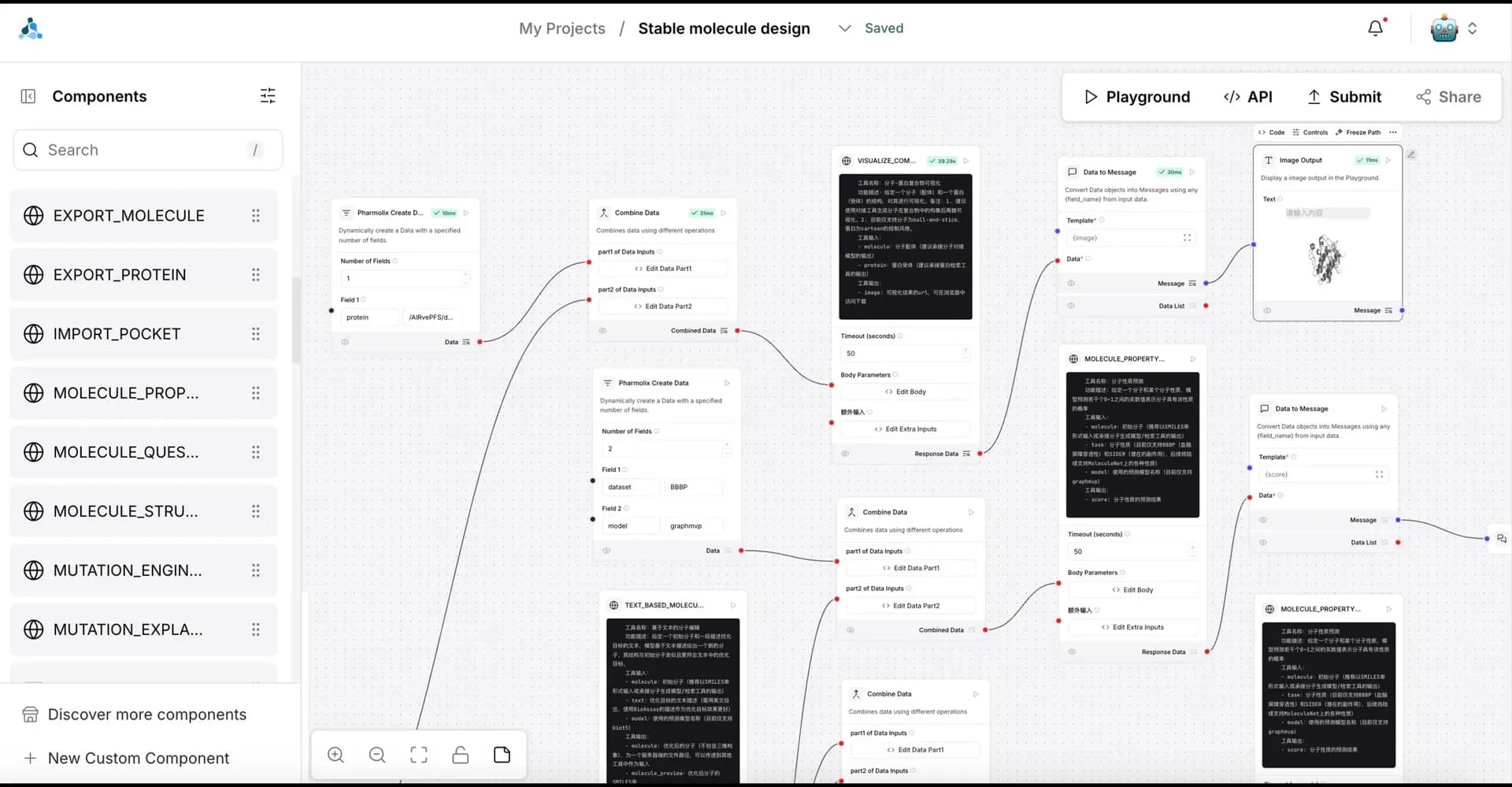
Integrates more than 10 algorithms, including in-house algorithms and advanced methods. Its accessible workflow and agent-building tools help researchers combine multiple tools into coordinated workflows for complex scientific questions and simulate iterative experimentation. Large language models synthesize the results to uncover potential scientific insights.

  • Multiple foundation models

    Works with multiple foundation models to automatically build collaborative workflows spanning multiple tasks.

  • Multiscale data

    Integrates data at atomic and molecular scales to cover core tasks in life-science research.

  • Natural-language interaction

    Supports flexible molecular design, property evaluation, and optimization through natural-language instructions.

PHARMOLIX · FOUNDATION MODELS

Multimodal foundation models for biomedical research

From specialized knowledge to molecular structures, our models support reasoning, molecular design, and multimodal analysis in biomedical research.

PharMolix-FM

Connects molecular and structural information through unified multimodal representations, supporting molecular docking, binding affinity prediction, and drug-likeness assessment for molecular design and optimization.

AgentKG:Defining Knowledge Graphs for AI Agents

Relationships
>100M

Relationships spanning drug–target interactions, therapeutic indications, and target–disease associations.

Text Chunks
>100M

High-quality text chunks linked to the graph from research papers, conference materials, and other authoritative sources.

Entities
>80M

Entities from authoritative sources, including drug targets, diseases, companies, and other key biomedical entities.

SnowballKG Agent

Iterative extraction: uses few-shot learning with a small seed dataset and human-in-the-loop feedback to incorporate expert knowledge into the knowledge graph.

Self-learning and adaptation: refines the system through active learning based on extraction results in each iteration, continuously improving performance on domain-specific subtasks.

Multilingual Cross-modal Retrieval Technology

Multimodal fusion: combines data from different modalities for more comprehensive understanding and retrieval. For example, combining text descriptions with image content improves retrieval accuracy and relevance.

Semantic understanding and matching: uses deep learning to interpret meaning and extract features across different data modalities, enabling semantic matching.

Relationship networkIllustrative view
  • Target
  • Drug
  • Disease
  • Literature
Drugs act on targets, drugs and targets link to diseases, and literature supports those relationshipsTargetDrugDiseaseLiterature

Papers

Loading…

Partners

Partner 1
Partner 2
Partner 3
Partner 4
Partner 5
Partner 6
Partner 7
Partner 8
Partner 9
Partner 10
Partner 11
Partner 12
Partner 13
Partner 14
Partner 15
Partner 16
Partner 17
Partner 18
Partner 19
Partner 20
Partner 21
Partner 22
Partner 23